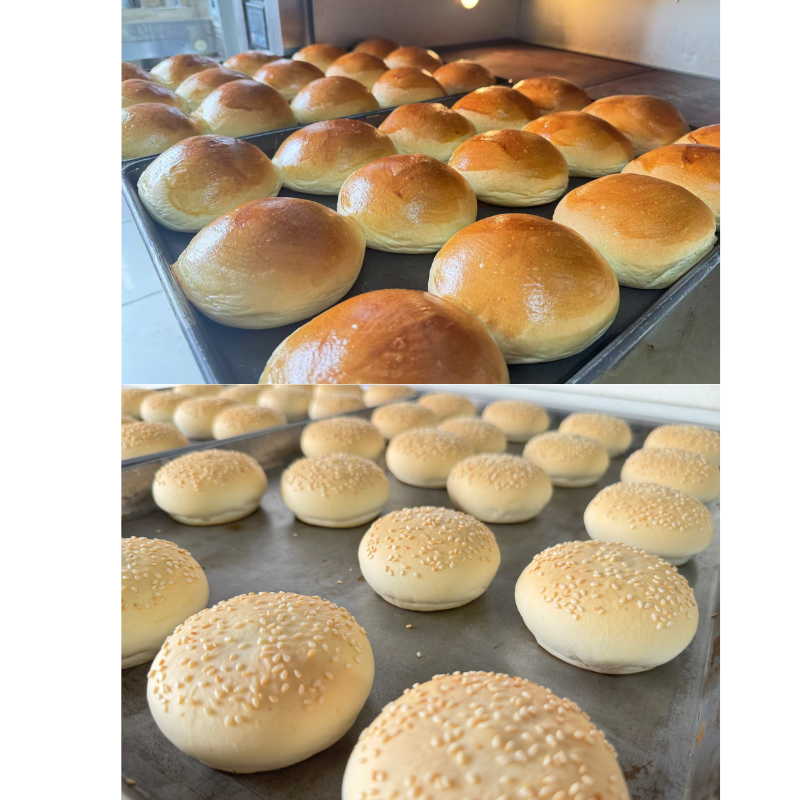
Walk through almost any industrial bakery, and you'll find the same thing: flour dust on every surface, trays of misshapen dough heading for the bin, an oven rack where one in ten loaves comes out slightly off, and a packaging line that trims more product than it should.
Nobody wants waste. But in a bakery running 16 hours a day, six days a week, small inefficiencies compound quickly.
Industry research puts waste and operational inefficiency at 8–15% of production costs for the average industrial bakery. For a facility doing $2 million a year in production, that's $160,000 to $300,000 walking out the door — not as finished product, but as trim loss, rejected batches, rework, downtime, and overproduction.
The good news? Most waste isn't inevitable. It's caused by specific, fixable mistakes in how production lines are set up, maintained, and managed.
Here are the 10 most common waste-generating mistakes we see in industrial bakeries, along with what actually works to fix them.
It seems counterintuitive — isn't more production better? Not when the extra loaves end up in the dumpster.
Overproduction is the single biggest source of waste in many bakeries. You bake for forecasted demand, the forecast is wrong, and by closing time you've got pallets of product with nowhere to go. Some can be discounted or repurposed, but much of it goes to waste.
A study of bakery AI automation found that ingredient waste from overproduction and spoilage typically runs 8–15% of total food costs. And it's not just the ingredients — it's the labor, energy, and packaging that went into product you never sell.
The fix: Move from batch-based production planning to demand-driven scheduling. Start with actual sales data from the last 4–6 weeks, not last year's forecast. Build smaller, more frequent production runs into your schedule rather than one massive daily batch.
Automation helps here too. Lines with quick changeover capability — like our
OC-1568I Pia Durian Cake Production Line, which can switch between filled product variants in under 30 minutes — let you produce what you actually need today, not what you guessed you'd need a week ago.
When you're making laminated dough, filled pastries, or shaped products, you trim edges to get the clean, uniform shape your customers expect.
Those trimmings add up.
For laminated doughs like croissants and Danish pastry, trim loss can account for 3–8% of total dough weight depending on product complexity and technique. That means for every 100 kg of flour you mix, 3 to 8 kg of finished dough never makes it into a saleable product.
Most bakeries track flour inventory. Few track actual yield — how much of the flour they buy actually ends up in finished, sellable product.
The fix: Calculate your actual yield versus theoretical yield for every product. Weigh the dough you make against the finished products that leave the production line. That real-world number should be your baseline, not the recipe formula.
Then invest in forming equipment designed to minimize trim. Precision dough stamping machines — like the
OC-850 Fully Automatic Stamping Machine — produce consistent shapes with minimal waste, especially for patterned or filled products where manual cutting generates significant trim.
Here's a fact every baker knows but few cost out: bread loses weight in the oven.
A 500-gram ball of sourdough doesn't become a 500-gram loaf. Water evaporates during baking — typically 12–15% for most breads. That water loss is real ingredient cost that doesn't appear in your finished product weight.
Why does this matter for waste? Because if you're pricing and portioning based on dough weight rather than finished product weight, you're silently losing margin on every loaf. And if your oven isn't consistent — some batches losing 12%, others 16% — your product weight varies, which means either giveaway (overweight units) or rework (underweight units).
The fix: Track finished product weight per batch, not just dough weight. Calculate your bake loss percentage for every product and build it into your portioning and pricing.
And invest in ovens with consistent temperature and humidity control. Uniform baking conditions mean uniform bake loss, which means consistent product weight, less giveaway, and fewer rejects. Our
commercial deck ovens with independent temperature control per deck give you that batch-to-batch consistency.
Your production line is only as fast as your slowest machine. But more than that — it's only as efficient as your least efficient machine.
A common mismatch we see: a high-capacity mixer feeding a divider that can't keep up. Dough sits around, over-proofs, and quality drops. Or a tunnel oven that's too fast for the packaging line, so finished product piles up and gets damaged while waiting.
Both scenarios create waste. It's just different forms of it.
Industry consultant David Tscheinig puts it bluntly: "We regularly see big oven capacity with a small mixer, or vice versa. Coldrooms are too big or too small, there's not enough storage space, and layouts don't always meet health regulations."
The fix: Balance your line. Every machine should be sized so that no single piece of equipment is operating above 85% of its rated capacity during normal production. The 15% buffer handles variation without creating waste.
Not sure where your bottleneck is? Start by timing each production stage for a full shift. The stage with a growing pile of work-in-progress in front of it? That's your bottleneck. Adding capacity there — not at the mixer or the oven — will give you the biggest waste reduction for the smallest investment.
Our
OC-221 Continuous Dough Divider is designed to match high-output mixing systems, ensuring dough moves smoothly from mixing to forming without sitting and waiting — a common source of quality variation and waste.
A machine that's running but not running well is a hidden waste factory.
Worn divider blades produce inconsistent piece weights. Dull dough cutters leave ragged edges and extra trim. Misaligned conveyors cause product damage. Clogged spray nozzles deliver uneven egg wash or glaze, creating rejects.
None of these are bad enough to stop production. None of them show up on a maintenance report as "breakdowns." But each one silently increases waste, shift after shift.
Preventive maintenance programs in bakeries typically cost 3–7% of equipment value per year — but they save far more than they cost by preventing both breakdown downtime and the slow, steady waste of poorly running machinery.
The fix: Implement a preventive maintenance schedule based on actual usage, not the calendar. Track key performance indicators per machine — weight variance, reject rate, downtime incidents — and use those metrics to drive maintenance priorities.
And choose equipment designed for easy maintenance. Machines with tool-less access to wear parts, modular component design, and clear maintenance procedures make it much easier to keep things running at peak efficiency. Our
OC-187 Dough Rounding Machine with its modular design and easily accessible components is a good example — maintenance takes minutes, not hours.
Dough temperature is one of those variables that seems minor until you track it.
If your dough is warmer one day and cooler the next, everything downstream changes. Proofing times vary. Oven bake times shift. Product consistency suffers. And inconsistency means rejects — product that doesn't meet quality standards and gets pulled from the line.
The problem is often at the mixer. Friction during mixing adds heat. If you're not controlling dough temperature during mixing — with chilled water, jacketed bowls, or controlled mixing cycles — your dough temperature will drift with ambient temperature, batch size, and mixing time.
The fix: Control dough temperature from the first minute of mixing. Use chilled water for warm climates, calculate friction factor for your mixer, and use mixers with bowl temperature monitoring.
Our
OC-50F Fully Automatic Cylinder Turning Dough Mixer features temperature monitoring and variable-speed control, so you can manage dough temperature consistently — batch after batch, day after day. Consistent dough temperature means consistent downstream processing, fewer rejects, and less waste.
In many bakeries, trays of dough or finished product move from one machine to the next by hand — or on carts pushed by workers.
Every time a human touches a tray, there's potential for damage. A bumped tray here. A dropped sheet there. A stack that slides. Product gets damaged, and damaged product becomes waste.
It's not just the dramatic spills, either. Minor jostling during manual transport can deflate proofed dough, cause filling to shift, or create surface imperfections that mean the product can't be sold at full price.
The fix: Automate tray handling wherever possible. Conveyors, automatic tray arrangers, and continuous production flow eliminate the need for manual transport between production stages.
An automatic tray arranging machine — like the
OC-860 High-Speed Tray Arranging Machine — positions dough pieces on trays consistently and gently, with zero manual handling. Less handling means less damage, and less damage means less waste.

When a batch doesn't meet spec, the instinct is to fix it. Rework the dough. Reshape the misformed pieces. Rebake the underdone loaves.
Sometimes rework makes sense. Often, it doesn't.
Rework consumes labor time that could be spent producing saleable product. It ties up equipment capacity. And it often produces a lower-quality product that sells at a discount — or doesn't sell at all.
The key question isn't "can we fix it?" It's "does fixing it actually save money?"
A 10-minute rework session that saves $20 of ingredients but uses $50 of labor and ties up a machine that could be producing $100 of good product isn't a savings. It's a loss.
The fix: Track rework time and cost, not just rework quantity. Set clear thresholds for when rework is worth it and when it's not. For low-value products with high labor rework cost, it's often better to write off the ingredients and move on.
Then address the root cause so the problem doesn't keep happening. If dough weight is inconsistent, fix the divider. If bake time is off, fix the oven. Rework is a band-aid; fixing the source of the problem is the cure.
Packaging waste is the easiest to see and often the last to get addressed.
Mis-sized packaging that doesn't fit the product properly. Over-packaging that uses more material than necessary. Packaging damaged during handling that has to be thrown away. Products mispackaged or mislabeled that need to be repackaged.
For many bakeries, packaging waste accounts for 2–5% of total packaging costs — not huge on a percentage basis, but significant in absolute dollars, and entirely preventable with the right approach.
The fix: Standardize packaging sizes per product category. Use packaging equipment with consistent sealing and cutting to reduce damaged packages. And invest in packaging machinery that's sized for your actual production volume, so you're not running a high-speed machine at half capacity (which increases per-unit packaging waste).
This is the meta-mistake that makes all the others possible.
If you're not measuring waste — tracking it, categorizing it, assigning it a cost — you can't manage it. You know there's waste. You can see it on the floor. But you don't know how much, where it's coming from, or what's causing it.
Without measurement, every waste reduction initiative is a guess.
What to measure (start with these):
-
First-pass yield: Percentage of product that passes quality inspection the first time
-
Waste by category: Ingredient waste / production waste / packaging waste / downtime waste
-
Waste cost per unit produced: Total waste cost divided by total units produced
-
Reject rate by production stage: Where in the line are most rejects happening?
The fix: Start simple. Pick one waste metric — first-pass yield is a good one — and track it every day for two weeks. You'll be surprised what you learn just from paying attention.
Then expand from there. The goal isn't perfect measurement. The goal is knowing where your biggest waste problems are, so you can fix the things that actually move the needle.
10 mistakes is a lot. Don't try to fix everything at once.
Start with the one or two sources of waste that cost you the most money. For most bakeries, that's either overproduction or equipment mismatch — the two biggest dollar-value waste categories.
Here's a simple action plan:
| Step |
Action |
Timeline |
| 1 |
Measure first-pass yield and waste by category for 2 weeks |
Weeks 1–2 |
| 2 |
Identify the single biggest waste source in your operation |
Week 3 |
| 3 |
Implement one targeted fix (equipment upgrade, process change, or training) |
Week 4–6 |
| 4 |
Measure improvement and calculate the ROI |
Week 7–8 |
| 5 |
Move to the next biggest waste source |
Ongoing |
Waste reduction compounds. Fix one thing, save money. Fix the next thing, save more. Within six months, many bakeries find they've cut waste by 30–50% without any major capital expenditure — just by addressing the specific mistakes that were costing them the most.
Waste in a bakery isn't a cost of doing business. It's a cost of doing business the way you've always done it.
Every mistake on this list is fixable. Some cost money to fix — new equipment, better layout, automation. Some cost only attention and discipline — better measurement, preventive maintenance, smarter production planning. But all of them have one thing in common: the sooner you address them, the more money you save.
If you're looking at waste in your production line and wondering where to start, we can help. We design complete bakery production lines with waste reduction built in — from precise portioning to consistent baking to automated handling that minimizes product damage. Our engineering team can audit your line and point out the specific waste points that are costing you the most.
Get a Free Production Line Waste Audit →
— we'll tell you where the money is going and what you can do about it.
How much waste does the average industrial bakery produce?
The average industrial bakery loses 8–15% of production cost to waste, including ingredient waste from overproduction and spoilage, production waste from rejects and rework, and downtime waste from equipment issues. Well-run operations can get this down to 3–5%.
What's the biggest source of waste in a bakery?
It varies by operation, but overproduction (baking more than you can sell) and equipment mismatch (bottlenecks that cause quality problems) are usually the top two. Both are fixable with better planning and properly sized equipment.
Can automation really reduce waste, or is it just about labor savings?
Automation reduces waste in several ways: more consistent portioning, gentler product handling, fewer human errors, and more predictable production scheduling. For many bakeries, the waste reduction from automation is as valuable as the labor savings.
How long does it take to see results from waste reduction efforts?
Some changes — better production planning, preventive maintenance, measuring waste — can show results in weeks. Equipment changes and layout changes take longer, typically 2–6 months for full payback depending on the scope of the improvement.
What's the first step to reducing waste in my bakery?
Start measuring. Pick one metric — first-pass yield is a great starting point — and track it every day for two weeks. Once you know how much waste you have and where it's coming from, you'll know exactly where to focus your efforts for the biggest return.